
Half-Power Outage Technical Guide for Bradenton Homes
A half-power outage can be confusing: some lights work, some do not, and big appliances act strange. This guide focuses narrowly on the technical causes and behavior of half-power conditions in a typical Bradenton or Sarasota home electrical system, and what you can safely observe without opening equipment.
How a Typical Bradenton Home Gets 120/240 Volts
Most homes in the Bradenton and Sarasota area are fed by a single-phase, three-wire 120/240-volt service from the utility transformer. The transformer secondary has two “hot” conductors (often called legs or lines) and one neutral. Each hot leg to neutral is nominally 120 volts, and the two hot legs are 180 degrees out of phase, so hot-to-hot is 240 volts.
Inside your main panel, standard 120-volt branch circuits (lighting, receptacles, many small appliances) connect from one hot leg to neutral, while 240-volt loads (electric range, water heater, dryer, many central AC condensing units) connect from one hot leg to the other hot leg. The panel bus bars are arranged so that adjacent breaker positions alternate between leg A and leg B, which helps balance load between the two legs when circuits are distributed properly.
A “half-power” or partial-power condition generally means there is a problem with one hot leg or with the neutral.
Technical Patterns of a Lost Hot Leg
When one hot leg is lost (open conductor, failed connection, or failed main breaker pole), the behavior follows a predictable pattern:
- All 240-volt loads that require both legs (e.g., typical electric range, electric dryer, straight-240 water heater) will be completely inoperative.
- All 120-volt loads fed from the missing leg will be dead.
- 120-volt loads on the remaining good leg will usually function normally.
Because breaker stabs alternate between legs, this often shows up as an “alternating” loss in the panel and in the home. In practice, it can look like every other breaker position is feeding dead circuits, and you may find one group of rooms or circuits still powered while others, often in a quasi-alternating pattern, are out.
At the symptom level, you may notice:
- Some rooms or outlets completely dead while others are fine.
- Electric oven or dryer not heating or not turning on at all.
- Heat pump or straight-cool AC not starting, or outdoor unit dead while the indoor air handler (usually 120 volts) still has power.
Common technical failure points for a lost leg include:
- Open conductor in the service drop or lateral from the transformer to the weatherhead/mast.
- Loose or burned connection at the service entrance lugs in the meter socket.
- Loose, overheated, or damaged connection at the main breaker lugs.
- Internal failure of one pole of the main breaker.
These locations are not safe to access without training and PPE, but understanding them helps interpret symptoms and communicate with professionals.
Technical Patterns of a Loose or Open Neutral
A loose, high-resistance, or open neutral in a 120/240-volt system is more dangerous than a simple lost leg, because it changes how voltages distribute between the two legs.
In a healthy system, the neutral conductor is solidly connected back to the transformer center tap. In normal operation, 120-volt loads on leg A and leg B share the neutral, and under load, the neutral current is the difference between the currents on the two legs, which keeps voltages close to 120 volts each.
When the neutral connection becomes loose or open between your panel and the transformer while both hot legs remain connected, the two 120-volt legs effectively become a 240-volt series circuit with your household loads acting as series resistances. The actual voltage on each side depends on the impedance (resistance and reactance) of the loads on that leg.
Resulting behavior:
- One side of the house may see elevated voltage (e.g., 130, 160+ volts) while the other side sees reduced voltage (e.g., 60, 90 volts).
- As loads turn on and off, the voltage division changes in real time. You can see lights brightening and dimming in different rooms as refrigerators, AC units, or well pumps start and stop.
Typical homeowner-visible symptoms of a loose or open neutral:
- Lights unusually bright in some rooms and very dim in others at the same time.
- Electronics (TVs, computers, chargers) failing in clusters after one event.
- Motors (refrigerators, fans, some AC equipment) humming, struggling to start, or overheating.
- Intermittent behavior that changes as large appliances cycle on and off.
From a technical perspective, a loose neutral can cause overvoltage stress on sensitive electronics on the “high” leg (capacitor failure, power supply damage) and undervoltage on the “low” leg, which can cause motors to draw higher current, overheat, and trip breakers. It can also lead to arcing at the neutral termination point, especially in meter sockets and main panels, which can cause significant thermal damage over time.
Common loose-neutral locations:
- Neutral connection in the meter base.
- Neutral lug in the main service disconnect or main breaker.
- Neutral splice in the service drop or service lateral connection at the weatherhead.
How to Distinguish Lost Leg vs. Neutral Problem From Symptoms
Without opening any equipment, you can make a preliminary distinction based on patterns.
Likely Lost Hot Leg if:
- All 240-volt appliances are dead.
- Roughly half of your 120-volt circuits are out, and those that are powered appear normal (no unusual bright/dim behavior).
- The issue appears suddenly and remains steady (does not fluctuate as loads change).
Likely Neutral Issue if:
- Some or most 120-volt circuits still have power, but you see a mix of very bright and very dim lights simultaneously.
- The behavior changes when large loads start or stop (for example, lights brighten when the AC shuts off).
- Electronics fail or behave erratically shortly after the event.
Safe Observations at the Panel Without Opening It
Even though you should not remove the panel cover, you can gather useful technical clues with the door closed. First, verify the main breaker handle is firmly in the “ON” position and not partway between “ON” and “OFF,” since a partially tripped main can mimic a lost leg if one pole has opened. Next, compare the pattern of dead circuits you observed in the house to the panel layout and consider whether they align more with every-other breaker positions (suggesting a single leg issue) or with a single local circuit (suggesting a branch-circuit problem). You can also lightly touch the outside of the panel enclosure with the back of your hand to check for abnormal warmth relative to the surrounding wall (do not do this if there is any sign of burning or arcing sounds). Localized heating on one side can suggest a heavily loaded or failing connection inside.
Service Drop, Meter Socket, and Mast, Technical Stress Points
From the ground, without touching or approaching the conductors, you can visually inspect the service components that often fail and cause half-power conditions:
- Service Drop Conductors: Look for conductors that appear frayed, pinched by tree limbs, or noticeably lower/sagging compared to the past.
- Weatherhead and Mast: Check whether the mast is plumb or appears pulled away from the roof or wall. Hurricane-force winds and flying debris can bend the mast or crack the weatherhead, stressing conductor terminations.
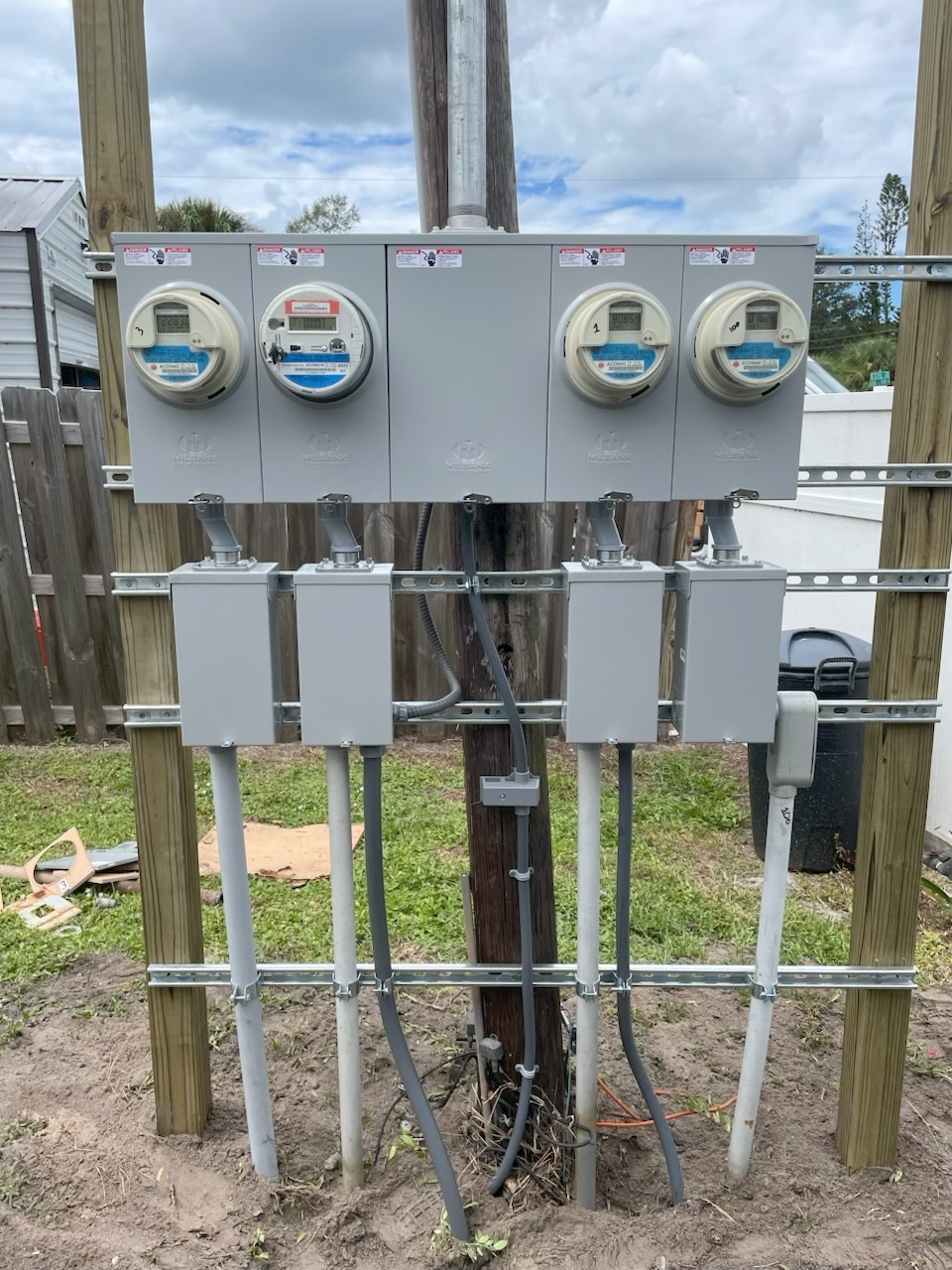
- Meter Base: Look for heat discoloration, melted plastic around the meter rim, or rust streaks that suggest long-term moisture intrusion.
- Conduit and Cable Clamps: Twisted or pulled conduit at the top of the meter or panel can indicate mechanical stress at the conductor lugs inside.
Any of these visible deformations increase the likelihood of high-resistance connections (both hot and neutral), which heat under load and can intermittently open one leg. They can also indicate insulation damage leading to arcing, especially under heavy load (e.g., during summer AC use or post-storm recovery when all loads come on at once).
Hurricane-Season Considerations for Half-Power Problems
During Florida’s hurricane season (August through October), there are specific mechanisms that often lead to half-power or neutral issues in Bradenton and Sarasota homes. Wind-induced movement is a common contributor: repeated swaying of the service drop in high winds can loosen terminations at the weatherhead or meter lugs over time, causing intermittent leg loss or neutral problems that may not show up until later under high load. Impact damage is another frequent cause, where tree branches or debris strike the service mast or pull on conductors, bending the mast or loosening lugs inside the meter base. Corrosion acceleration also matters, because wind-driven rain and salt air intrusion into meter sockets and panel seams can speed corrosion on lugs and bus bars, increasing contact resistance and heat. Finally, post-storm load surges can expose marginal connections: after an extended outage, many loads start up simultaneously (refrigerators, AC, well pumps), stressing already weakened connections and revealing problems with legs or neutrals.
Technical steps you can take before hurricane season:
- Document normal operation: note which breakers feed which rooms and major appliances while everything is working correctly.
- Label critical 240-volt loads (AC, well pump, range, water heater) at the panel so you can quickly see if all of them fail at once, which points to a leg problem.
- Keep vegetation trimmed away from the service drop to reduce mechanical stress during storms.
After a storm, if you notice half-power or neutral-related symptoms, avoid adding load (especially 240-volt loads) until the issue is evaluated.
When Symptoms Indicate an Urgent Technical Problem
Treat the situation as urgent, not routine, when you observe:
- Simultaneous bright and dim lighting in different rooms.
- 240-volt appliances dead while some 120-volt circuits still operate.
- Repeated tripping of the main or multiple breakers immediately upon reset, especially after a storm.
- Any burning odor or visible heat damage at the meter, mast entry, or panel exterior.
These are strong indicators of:
- Open or high-resistance leg connection.
- Loose/open neutral.
- Overheating and arcing at terminations.
Summary: Recognizing Half-Power Electrical Behavior
By focusing on the patterns of what works and how it behaves, you can narrow a half-power event to a probable lost leg vs. neutral issue without opening equipment. A lost leg means one hot conductor is effectively missing, leading to dead 240-volt loads and dead circuits in an alternating pattern, with normal behavior on remaining circuits. A loose or open neutral, by contrast, creates unstable voltage division between legs, producing bright/dim swings, equipment stress, and behavior that changes as large loads cycle.
Understanding these technical patterns helps you explain the situation accurately, prioritize safety, and ensures that when a qualified professional arrives, they can move directly to the most likely failure points in your Bradenton or Sarasota home’s electrical system.
Protect Your Home With Expert Electrical Troubleshooting
If you are noticing flickering lights, tripping breakers, or outlets that feel warm, our licensed team at Power & Lighting Solutions can help you stay safe with professional electrical troubleshooting in Sarasota. We carefully inspect your panel and wiring to identify the true source of the problem before it turns into a major repair. Reach out today and let us restore reliable power throughout your property. For scheduling or questions, simply contact us.
Leave a Reply